Zeitgeist prediction markets and outcome payouts
Zeitgeist is a prediction-market blockchain where traders buy outcome tokens whose redemption value follows a market's resolved result. An outcome token represents a claim tied to a specified event or numerical result. Trading prices reflect market expectations while markets remain open. Final payouts depend on the outcome, the market type, and its settlement rules. The protocol also supports market creation, liquidity provision, combined positions, and futarchy, which uses predictions to inform governance decisions.
UpdatedThe short version: A market with disputes enabled can remain unresolved after trading closes, so its outcome tokens cannot yet redeem for collateral.
Prices express forecasts before settlement
While trading remains open, an outcome token's price expresses market expectations, and available liquidity affects its execution price. For ordinary categorical tokens, dividing the price by the winning token's redemption value gives an implied probability before fees. That interpretation reflects traded prices, including participants' information and incentives. Thin liquidity can make a small trade move the price substantially. A quoted price describes what the trading mechanism offers at that moment; resolution establishes the contractual payout.
Categorical, scalar, and combined positions
Categorical and scalar markets define the underlying outcomes; combinatorial tokens combine those outcomes into positions whose value depends on several markets.
Categorical outcomes
Categorical markets define distinct options, including binary Yes and No choices. In the ordinary outcome-token model, the winning category redeems for the full unit of collateral, and other categories have zero redemption value. Categories need to cover possible results without overlapping. A broad event label is insufficient when its resolution criteria distinguish dates, measurements, or alternative interpretations.
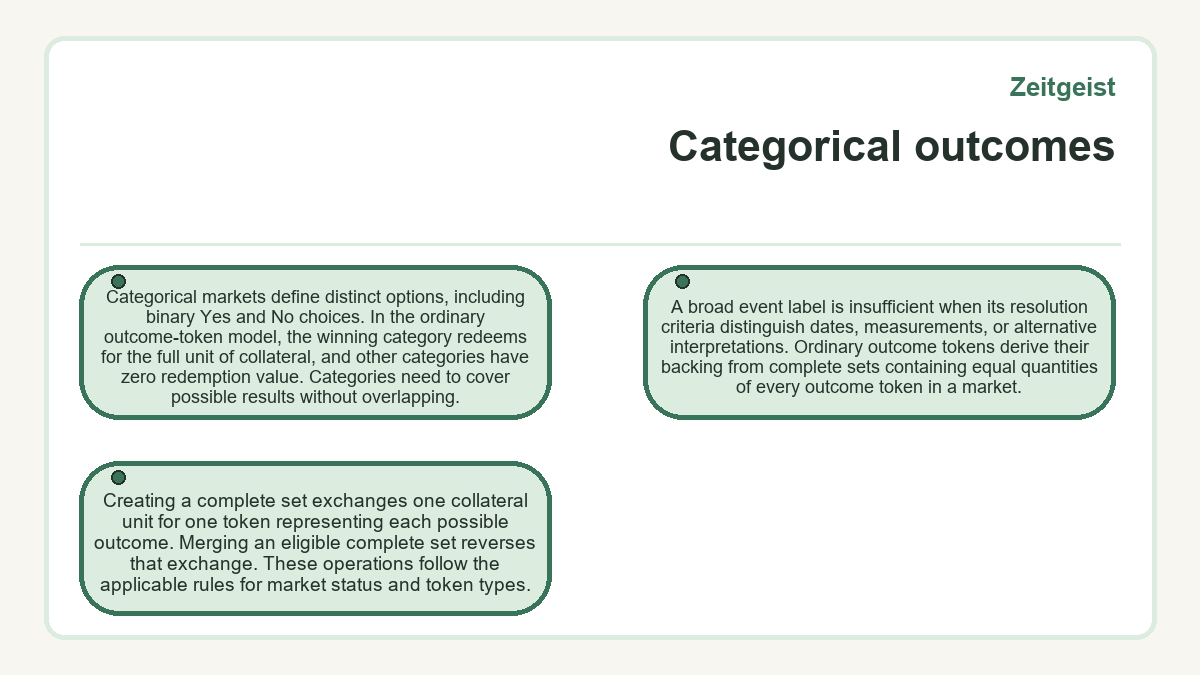
Ordinary outcome tokens derive their backing from complete sets containing equal quantities of every outcome token in a market. Creating a complete set exchanges one collateral unit for one token representing each possible outcome. Merging an eligible complete set reverses that exchange. These operations follow the applicable rules for market status and token types.
Long and Short shares
Scalar markets resolve to a numerical value. Long and Short are the outcome assets, and their payouts follow the market's lower and upper bounds. Within the range, Long's payout increases as the resolved value rises; Short receives the complementary fraction. At or beyond a boundary, one side receives the full collateral unit and the other receives zero. A resolved value between the bounds can therefore give both sides a positive payout.
Combinatorial tokens
Combinatorial tokens represent combinations or collections of outcomes. Splitting and merging let the protocol express joint events and conditional exposure across underlying markets. Resolution of one underlying market can convert a combined token into exposure to a market awaiting resolution. Receiving another outcome token does not necessarily mean receiving spendable collateral.
Neo Swaps, order matching, and parimutuel pots
A market's trading mechanism determines where counterparties or liquidity come from and whether its shares permit an exit before settlement.
Neo Swaps liquidity pools
Neo Swaps uses the Logarithmic Market Scoring Rule to calculate prices and swaps. Liquidity providers supply pool capital and receive pool shares representing their participation.
Trading changes the pool's asset balances and therefore changes prices. Larger trades relative to pool depth create more price impact. Providers receive swap fees, while their remaining inventory exposes them to outcome risk. The backing reserved for redemption and the liquidity available for trading perform different jobs; sufficient collateral backing does not establish a good selling price.
Orders against other traders
The order book pairs outcome assets with their market's base asset. A maker specifies the amounts offered and requested, which defines the exchange price. A taker must accept and fill the order before an exchange occurs. Posting an order therefore leaves an instruction awaiting execution, and an unmatched order cannot provide an immediate exit.
Parimutuel betting
Parimutuel markets pool wagers and distribute the pot among holders of winning shares in proportion to their participation. Zeitgeist restricts this mechanism to categorical markets. Additional bets can change the eventual payout ratio, and the protocol does not support selling these shares before settlement. This mechanism uses participants' wagers instead of a separately funded trading pool.
ZTG, collateral, and developer access
ZTG is the network's native token, while a market's chosen base asset determines the currency underlying its outcome payouts. Registered foreign assets can serve as collateral when their registry settings allow use as base assets. Token balances therefore need their asset identity as well as their quantity. ZTG also supports governance and bonds for actions such as market creation and disputes. The network uses Substrate and runs as a Polkadot parachain following its migration from Kusama. Applications need a connection to the intended network to read its markets and submit transactions.
The software development kit (SDK) provides another entry path for software integrating market data and chain interactions. Its full mode combines indexed data with direct chain access. Remote procedure call (RPC) mode queries the chain, and indexer mode reads indexed data. Indexer mode cannot submit transactions. Developers can connect to mainnet, Battery Station for testing, or a local development environment. An indexer's latest display and the chain's latest state may differ while indexing catches up.
Market creation and readable resolution terms
Market creation establishes the question, outcome definitions, collateral, oracle, deadlines, and resolution rules participants trade against. Permissionless creation requires a validity bond; advised creation requires approval from the Advisory Committee. The protocol keeps an advised market proposed until approval, so proposed status does not authorize ordinary trading. Bond requirements and fee settings come from the applicable configuration.
Clear terms identify the event's cutoff, the measurement's units, and the evidence determining the result. Ambiguous wording can leave two participants trading different interpretations of the same question. Approval concerns market quality and rule compliance; the written question and its settlement criteria still determine the position's exposure.
When can Zeitgeist outcome tokens be redeemed?
Ordinary outcome-token redemption requires a resolved market, so reaching the trading cutoff alone does not make the collateral payable to token holders. For markets with disputes enabled, the configured grace period, reporting window, and dispute process determine the route from closure to resolution. A report gives participants an opportunity to challenge the outcome during the dispute window. A successful challenge can change the final result, and dispute proceedings can extend the wait for redemption.
For ordinary categorical outcome tokens, each winning share redeems for one unit of the market's collateral after resolution. A signed redemption transaction consumes the redeemable tokens and transfers their corresponding collateral on successful execution. Selling while a market remains open exchanges tokens at the available trading price. These operations have different prerequisites and can return different amounts. The resolved payout follows the final outcome even when the last quote suggested a different probability.
Dispute routes and position choices
The chosen dispute mechanism determines who can reconsider an outcome report and which financial commitments accompany a challenge. The decentralized court selects participants from a pool of ZTG stakers and uses commit-reveal voting. Jurors commit to a vote before publishing it, and appeals can trigger additional rounds. Under qualifying escalation conditions, global disputes let ZTG holders lock tokens behind an outcome; the outcome with the greatest locked balance wins.
Authorized dispute resolution places the decision with the Advisory Committee. Trusted markets omit the dispute mechanism and resolve directly from the designated oracle's report after closure.
For a position you may need to sell before settlement, the available trading mechanism determines whether an exit is possible.
- Choose ordinary tradable outcome tokens only when the market remains open and a funded pool or fillable order supports the intended trade.
- Choose parimutuel exposure only if holding through settlement fits the task, because the protocol does not allow selling those shares.
- Match a categorical position to the written outcome criteria, including any catch-all category covering other results.
- Read scalar bounds before choosing Long or Short; those bounds govern the fraction of collateral each share receives.
- Treat a combined position as exposure to every unresolved underlying market when assessing whether redemption returns collateral or another token.
Futarchy and markets built into other applications
With a measurable governance objective, futarchy uses market predictions to evaluate proposals against that objective, extending the protocol beyond individual trading positions. An organization chooses what its measure of success represents. Conditional markets then express expectations about how a proposal affects that measure. The protocol includes a futarchy component, while submission authority and execution rules govern how a proposal enters that system. Market prices alone do not grant an arbitrary caller permission to enact a decision.
The same infrastructure can support event forecasting or exposure to defined political, sporting, and cryptocurrency outcomes. Event-linked payouts can provide a hedge against a defined outcome, with the hedge limited by the market's wording and payout currency. Combined tokens supply conditional positions, and a supported liquidity mechanism prices them. Combinatorial liquidity pools require underlying markets with the same collateral asset. Zeitgeist implements these pools through Neo Swaps.
Your questions, answered
Does a winning position always produce a net profit?
A winning position produces a net profit only when the collateral value returned exceeds its acquisition cost and all associated charges, including trading fees and transaction costs. Changes in the collateral asset's external value also affect results measured in another currency.
Do I need to operate a node to access Zeitgeist markets?
You can access the network through an application or an SDK connected to a remote node without operating your own node. Running a local node is a separate development or infrastructure choice. Reading indexed market data also differs from signing and submitting a transaction.
Why does placing an order reduce the balance available for other transactions?
An open order reserves the maker's offered assets for the portion awaiting execution. Those assets remain committed to the order and cannot fund another transaction simultaneously. The reserved asset depends on whether the order offers collateral or outcome tokens.
Can a taker fill only part of an order?
The order book supports partial fills as well as complete fills. A partial fill exchanges the corresponding portion of the offered and requested assets, leaving the rest of the order open. Market creator fees use the market's base asset, so the outcome-token quantity alone does not describe every balance change.
Which token does Battery Station use for testing?
Battery Station uses ZBS as its test-network token. Some SDK and command-line documentation labels the corresponding currency ZTG for consistency across environments. That naming convention does not turn a test-network balance into mainnet ZTG; the connected network determines which balance a transaction uses.
What happens if nobody backed the winning parimutuel outcome?
If the winning parimutuel outcome has no issued shares, participants can retrieve the collateral represented by their other shares under the protocol's refund rule. Potential external fees already paid remain outside that refund. This exception applies specifically to parimutuel markets.
Is a cancelled event automatically eligible for a refund?
A cancelled event follows the market's written resolution criteria and available outcomes. A defined cancellation or catch-all category can determine the winning token. Cancellation alone does not establish a universal refund entitlement across the protocol's different market mechanisms.
Where does the application get a market's title and description?
The application retrieves a market's title and description from its off-chain metadata. In the IPFS metadata model, the chain stores a hash identifying that content. Displaying those fields requires retrieving the matching metadata, while the chain separately records the market's operational state.