Zeitgeist court stakes and juror penalties
Zeitgeist's court design penalizes jurors who fail to vote or reveal by slashing their ZTG stake selected for the case. A revealed vote against the winning outcome can also incur a penalty. Delegation carries this exposure through the juror who receives the voting weight. The court combines secret commitments, public reveals, and appealable rulings to resolve disputed prediction-market reports. These rules concern markets configured for court resolution, and participation requires an operating chain accepting the relevant calls.
UpdatedA valid reveal prevents an inactivity penalty, while voting against the court's winning outcome still exposes the selected ZTG stake.
Which ZTG can a juror lose in a court case?
A juror risks the stake units the selection process assigns to the case, with each draw linking voting weight to a slashable balance. The account's total court stake determines its place in the selection pool. A particular round selects part of the available stake and records the amount at risk. One account can supply several units, so the number of selected units does not establish the number of different jurors.
Registration alone does not expose every token in an account to one case. The amount a round selects can nevertheless include a substantial part of a participant's court stake.
The runtime keeps the juror's vote state alongside the selected balance. A juror who fails to reveal loses the ZTG stake selected for that case when the closed court reassigns stakes. A missing commitment and a successfully denounced commitment also lead to slashing at reassignment. Reassignment takes the full slashable balance recorded for those selected draws.
Revealing a vote avoids the inactivity category, but the revealed outcome still determines the financial result. The court aggregates voting weights and adopts the outcome with the highest total, subject to its fallback rules. A juror's independently reasoned answer can therefore lose its selected stake when it differs from the court's winner. Because slashing follows the adopted outcome, agreement among jurors does not by itself prove the underlying report correct.
Commitment voting and the reveal deadline
The vote phase records a hash commitment, and the later aggregation phase accepts the corresponding outcome and salt as a public reveal. A salt is an additional value included when constructing the hash. The commitment binds the juror account to the chosen vote item and that salt. Including the account prevents another juror from treating the same commitment as their own valid reveal.
At revelation, the runtime hashes those inputs again and compares the result with the recorded commitment. It also checks the caller's selection and the outcome's compatibility with the market.
Each court round stores end blocks for the voting, aggregation, and appeal phases. The runtime accepts a reveal after voting ends and through the aggregation end block. Possessing the correct outcome and salt after that window does not make a late reveal valid. Scheduled request blocks organize the start of voting, while each case's recorded boundaries determine which action the runtime accepts at a particular block.
Secrecy lasts only until the reveal phase. During voting, another account can denounce a juror by supplying the vote item and salt matching the commitment. A successful denunciation changes the vote state and exposes the associated selected stakes to penalties. The salt therefore needs protection before voting closes, alongside retention for the later reveal. A denounced juror cannot restore that round's vote by submitting a later reveal.
Delegation transfers voting power and preserves stake exposure
A delegator supplies stake while an active juror handles the commitment and reveal duties associated with its selected voting weight. When the selection algorithm draws a delegated unit, it assigns that weight to a valid juror from the delegator's list. The delegator retains the financial exposure for the corresponding unit. A missing reveal, successful denunciation, or losing vote by the assigned juror can therefore reduce the delegator's ZTG balance.
Configured stake units and appeal limits
The runtime specification 62 configuration sets the stake unit, appeal-bond base, and final appeal boundary shown here. A runtime upgrade can change these values, so they describe this configuration rather than an immutable property of every deployment.
| Parameter | Configured value | Exposure or limit |
|---|---|---|
MinJurorStake
|
500 ZTG | Minimum entry stake and unit of case-selected exposure |
AppealBond
|
2 000 ZTG | Base amount multiplied for each appeal, not the first appeal's full bond |
MaxAppeals
|
4 appeal calls | Three additional court rounds; the fourth appeal permits escalation |
The initial court round requests 31 stake units. At appeal index
a, the requested weight follows
2^a × 31 + 2^a - 1, beginning with
a = 0. Multiplying that weight by
MinJurorStake
gives the total ZTG the round requests from the pool. The formula describes aggregate requirements, while individual selections assign the risk to particular accounts.
Appeals enlarge the jury and put a separate bond at risk
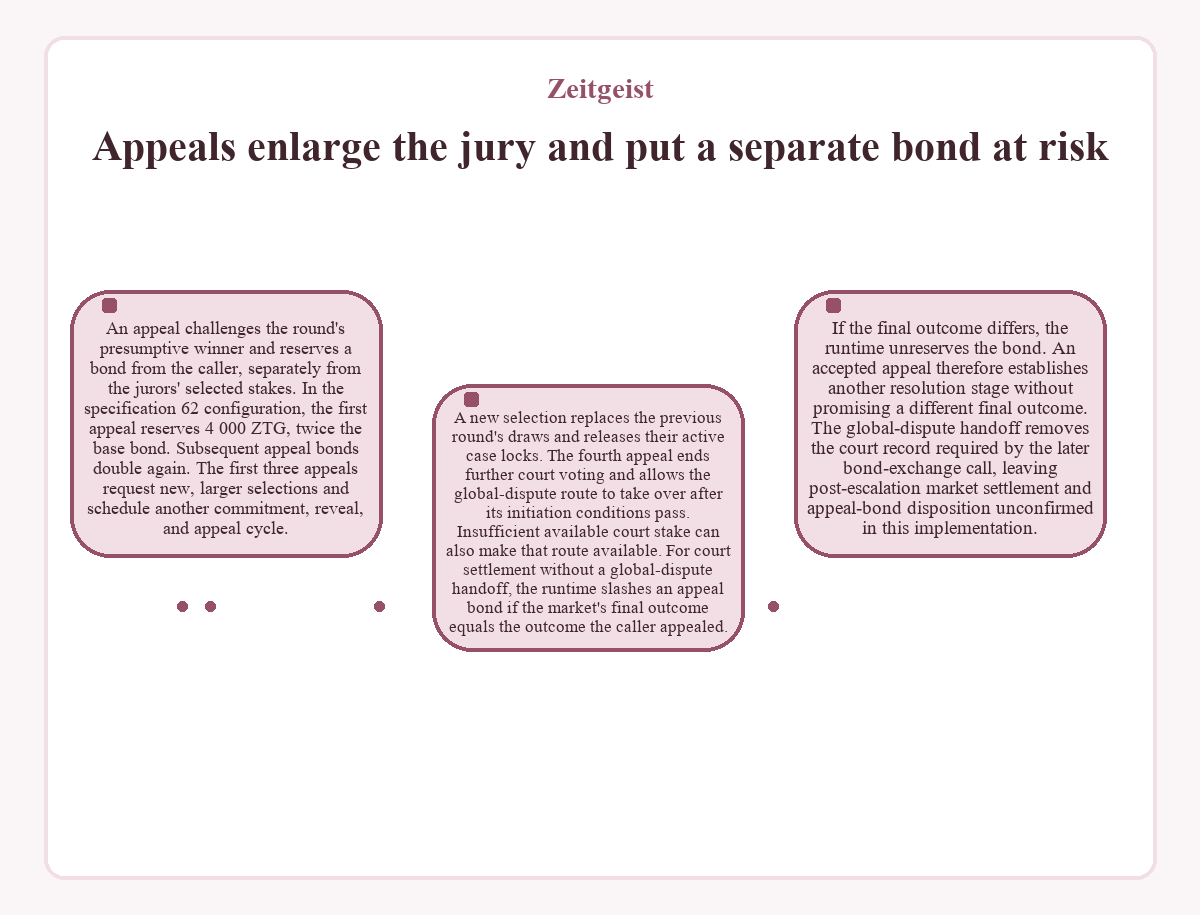
An appeal challenges the round's presumptive winner and reserves a bond from the caller, separately from the jurors' selected stakes. In the specification 62 configuration, the first appeal reserves 4 000 ZTG, twice the base bond. Subsequent appeal bonds double again. The first three appeals request new, larger selections and schedule another commitment, reveal, and appeal cycle. A new selection replaces the previous round's draws and releases their active case locks.
The fourth appeal ends further court voting and allows the global-dispute route to take over after its initiation conditions pass. Insufficient available court stake can also make that route available. For court settlement without a global-dispute handoff, the runtime slashes an appeal bond if the market's final outcome equals the outcome the caller appealed. If the final outcome differs, the runtime unreserves the bond. An accepted appeal therefore establishes another resolution stage without promising a different final outcome. The global-dispute handoff removes the court record required by the later bond-exchange call, leaving post-escalation market settlement and appeal-bond disposition unconfirmed in this implementation.
Final resolution, stake reassignment, and leaving the pool
A closed court fixes its winner, while stake reassignment separately applies penalties and distributes the resulting rewards to eligible winning jurors and delegators. The distribution follows each winner's share of the selected winning stake. Completing a reveal does not establish that reassignment has happened. The court's reassigned state records completion of this separate operation, and the runtime rejects an attempt to reassign the same case twice.
In specification 62, starting a global dispute clears the selected court draws and releases their active case locks without court stake reassignment. A global dispute uses ZTG-backed outcome voting across token holders rather than another randomly drawn jury. The outcome attracting the greatest voting balance determines resolution under that mechanism. Its vote locks follow separate release rules after the dispute finishes. These distinctions affect outcome redemption because market settlement must use the applicable mechanism's final outcome, not an earlier presumptive court winner.
Leaving the court pool also has its own timing and balance constraints. An exit request removes the participant from future selection, and a separate exit call releases unused stake after the configured waiting period. Funds covering active cases remain locked. A participant choosing between juror duty and delegation faces the same withdrawal constraint, with different responsibility for meeting the voting windows.
Zeitgeist: quick answers
Does every Zeitgeist market use the court for disputes?
Court resolution applies only when the market specifies the court dispute mechanism. Markets can instead specify authorized resolution or omit a dispute mechanism. The court rejects incompatible market configurations, so an outcome report alone does not establish that jurors will adjudicate it.
Can a juror replace a commitment before voting closes?
A selected juror can replace a recorded secret commitment during the vote phase. The runtime accepts this update while the vote remains in a permitted state. The later reveal must match the replacement commitment, including its vote item and salt.
What happens when the vote and salt fail to match the commitment?
The runtime rejects the reveal with CommitmentHashMismatch when the supplied inputs do not reproduce the recorded hash. That failed call does not create a revealed vote. Without a valid reveal during aggregation, the selected stake remains exposed to the inactivity penalty.
Are tied court vote totals settled by a random draw?
A tie between the highest weighted totals uses the previous round's appealed outcome when one exists. Without that prior outcome, the court falls back to the oracle report. A round with no revealed votes also falls back to the oracle report.
Which accounts can receive a court delegation?
A delegation list must contain distinct, valid active juror accounts and cannot include the delegator's own account. The runtime rejects an empty list. Selection considers jurors who remain valid when it draws the delegated stake, so earlier eligibility does not guarantee continued eligibility.
Why can joining fail despite meeting the minimum court stake?
A full court pool requires a newcomer to stake more than its lowest-staked participant. Meeting the entry minimum alone does not satisfy that replacement rule. Joining also requires enough balance for the stated stake, and an existing participant cannot reduce it through another join call.
Where do court inflation rewards come from?
Court inflation rewards come from newly minted ZTG, separately from penalties redistributed after a case. Governance controls the inflation rate. The configured period, stake eligibility, and participant's proportional share determine the distribution, so a court stake does not imply a fixed personal return.
Do additional selected stake units require separate court votes?
Each juror account has one recorded commitment per court round, and its assigned weight determines how much the revealed outcome counts. Several selected units can therefore support the same recorded vote. Delegated weight assigned to that juror follows the same revealed choice.